Chicago V Morales Case Summary
On Writ of Certiorari to the Supreme Court of Illinois. The Supreme Court of Illinois affirmed the appellate courts judgment holding that the ordinance violated the Due Process Clause of the Fourteenth Amendment because it was impermissibly vague.
Chicago V Morales C Span Org
Under the ordinance if a police officer observes a person whom he reasonably believes to be a gang.

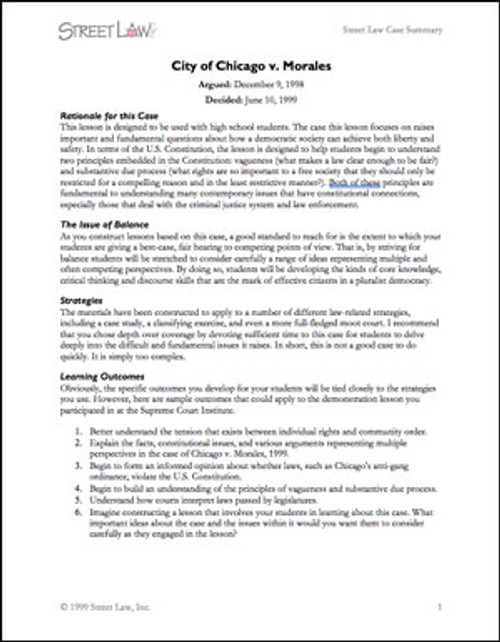
Chicago v morales case summary. Argued December 9 1998-Decided June 10 1999. Morales 1999 Morales 1999 a divided supreme court decided that the ordinance that gave the police the power to order groups of loiterers to disperse or face arrest was void for vagueness. Morales SCOTUS - 1999 Facts.
United States Supreme Court Petitioners Brief. 10061999 The duly elected members of the Chicago City Council enacted the ordinance at issue as part of a larger effort to prevent gangs from establishing dominion over the public streets. 4415 June 10 1999 declared the ordinance unconstitutionally vague because of its broad sweep and the vast discretion.
MORALES et al1999 No. By invalidating Chicagos ordinance I fear that the Court has unnecessarily sentenced law-abiding citizens to lives of terror and misery. Anyone who does not promptly obey such an order has violated the ordinance.
CITY OF CHICAGO Petitioner v. The Illinois Supreme Court held that Chicagos Gang Congregation Ordinance was unconstitutionally vague and the Supreme Court of the United States granted certiorari. City of Chicago v.
However the state appellate court reversed his conviction. ON WRIT OF CERTIORARI TO THE SUPREME COURT OF ILLINOIS June 10 1999 Justice Stevens announced the judgment of the Court and delivered the opinion of the Court with respect to Parts I II and V and an opinion with respect to Parts III IV and VI in which Justice Souter and Justice Ginsburg join. City of Chicago v.
Morales defendant was convicted under the ordinance. JESUS MORALES et al. D and others were charged under a new ordinance passed by the City of Chicago prohibiting gang members from loitering with one another in public places.
Any fool would know that a. CITY OF CHICAGO v. According to the ordinance a police officer may order anyone.
Jesus MORALES et al. CITY of Chicago Petitioner v. 41 1999 the Supreme Court held that a Chicago gang loitering ordinance which prohibited individuals whom police reasonably believed to be members of a criminal street gang from loitering in public with one or more persons was unconstitutionally vague.
Chicagos Gang Congregation Ordinance prohibits criminal street gang members. Under the ordinance if a police officer observes a person whom he reasonably believes to be a gang member loitering in a public place with one or more persons he shall order them to disperse. 2d 67 1999 US.
Jesus MORALES et al Respondents. Under Chicagos Gang Congregation Ordinance criminal street gang members are prohibited from loitering with one another or with other persons in any public place. The United States Supreme Court granted certiorari.
CROWE Corporation Counsel of the City of Chicago LAWRENCE ROSENTHAL FN Deputy Corporation Counsel. 10061999 CITY OF CHICAGO PETITIONER v. First it held that the ordinance was void for vagueness both because it failed to give notice of what conduct it prohibited and because it vested too much discretion in police officers.
December 9 1998 Decided. From loitering in public places. The aboveentitled matter came on for oral argument before the Supreme Court of the United States at 1003 am.
2d 67 1999 Brief Fact Summary. Ultimately after Morales challenged his arrest the Illinois Supreme Court held that the ordinance violated due process of law in that it is impermissibly vague on its face and an arbitrary restriction on personal. On June 10 1999 the US.
In City of Chicago v. 09121998 In 1993 Jesus Morales was arrested and found guilty under the ordinance for loitering in a Chicago neighborhood after he ignored police orders to disperse. In 1993 Jesus Morales was arrested and found guilty under the ordinance for loitering in a Chicago neighborhood after he ignored police orders to disperse.
Youkhana the Circuit Court of Cook County in a written opinion granted the motion to dismiss of fourteen defendants who had been arrested for violating the ordinance. Ultimately after Morales challenged his arrest the Illinois Supreme Court held that the ordinance violated due process of law in that it is impermissibly vague on its face and an arbitrary restriction on personal liberties. Justice Stevens writing for the majority in Chicago v.
Citation 22 Ill527 US. The ordinance is not vague. Ultimately after Morales challenged his arrest the Illinois Supreme Court held that the ordinance violated due process of law in that it is impermissibly vague on its face and an arbitrary restriction on personal liberties.
BRIEF FOR THE PETITIONER BRIAN L. In City of Chicago v. 09121998 CITY OF CHICAGO v.
Chicagos Gang Congregation Ordinance prohibits criminal street gang members. CERTIORARI TO THE SUPREME COURT OF ILLINOIS. Supreme Court in a split decision struck down a Chicago ordinance designed to prevent loitering by gang members.
City of Chicago v. United States Supreme Court Official Transcript. 2 The court held that the ordinance was unconstitutional on three grounds.
From loitering in public places. City of Chicago v. 09121998 In 1993 Jesus Morales was arrested and found guilty under the ordinance for loitering in a Chicago neighborhood after he ignored police orders to disperse.
Saenz V Roe 1999 Street Law Inc

City Of Chicago V Morales 527 U S 41 1999 Case Brief Summary Quimbee


Komentar
Posting Komentar